
09.21.2026
The Cost of Undocumented Warnings: How a Taiwan Trademark Infringement Case Collapsed
SHARE


More Details
1. Preamble
Trademark owners often assume that a clear history of unauthorized use, especially by someone who once had a business relationship with them, is sufficient to support a criminal infringement case. In practice, Taiwan’s courts hold prosecutors to a much higher standard. Criminal liability under Article 95 of the Trademark Act requires proof that the defendants knew, at the time of use, that they were infringing another party’s registered rights. Informal warnings and even genuine but undocumented conversations may still fall short of that evidentiary standard. In the case of Taiwan Taipei District Court 113 Yi-Zhi No. 52 Criminal Judgment [1], it is illustrated how costly that gap can be.
2. Regulation
Criminal penalty for trademark or collective trademark infringement is stipulated by Paragraph 1 of Article 95 of the Taiwan Trademark Act:
Any person who commits any of the following acts, without the consent of the proprietor of a registered trademark or collective trademark, shall be liable to imprisonment for a period not exceeding three years and/or a fine not exceeding NT$200,000:
(1) Using a trademark which is identical with the registered trademark or collective trademark in relation to goods or services which are identical with those for which it is registered;
(2) Using a trademark which is identical with the registered trademark or collective trademark and used in relation to goods or services similar to those for which the registered trademark or collective trademark is designated, and hence there exists a likelihood of confusion on relevant consumers; or
(3) Using a trademark which is similar to the registered trademark or collective trademark and used in relation to goods or services identical with or similar to those for which the registered trademark or collective trademark is designated, and hence there exists a likelihood of confusion on relevant consumers.
3. Background
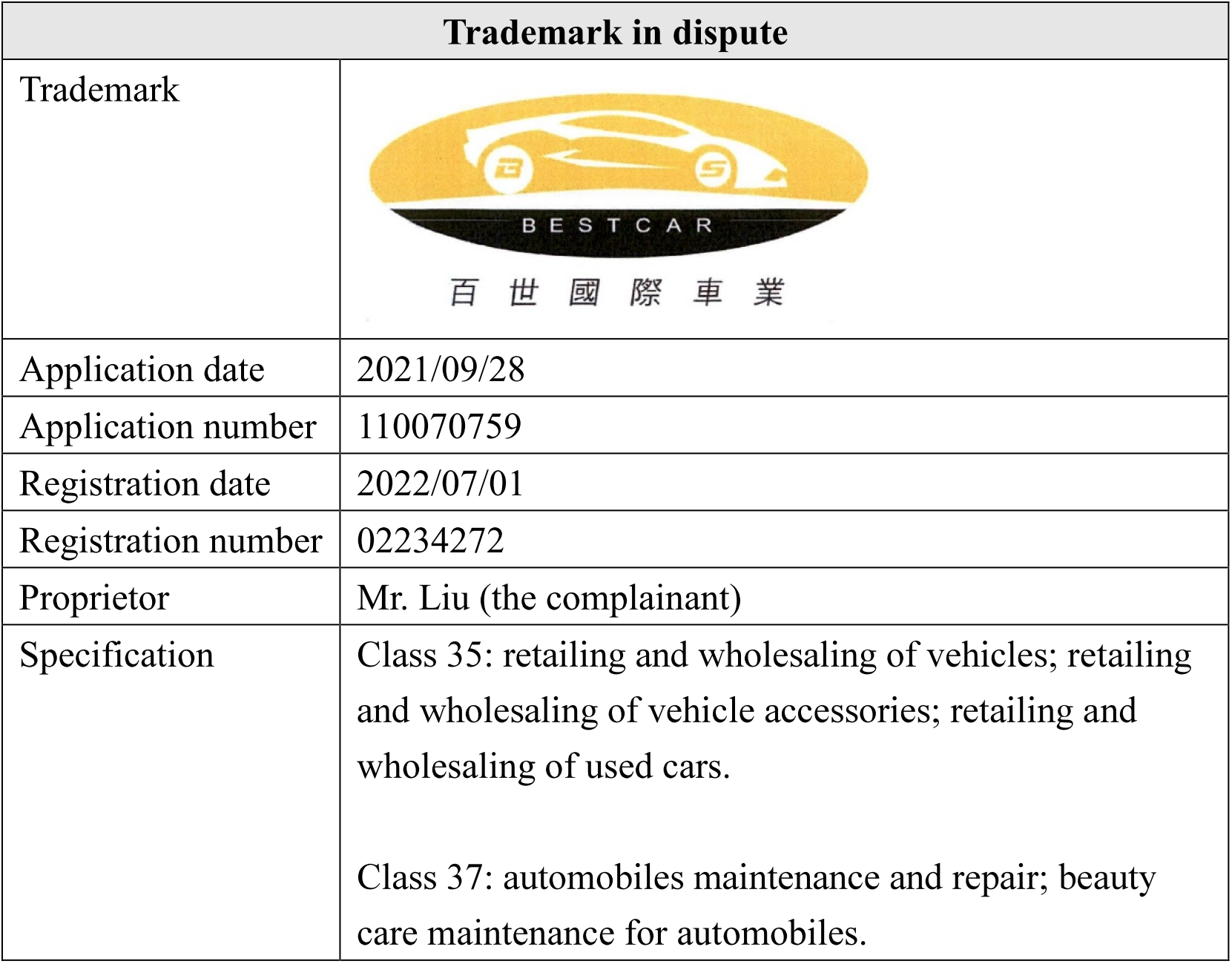
The complainant and the defendant jointly operated an automobile repair and maintenance business from March 2018 to August 2019. During this period of cooperation, the defendant set up and ran online shops on the Ruten and Yahoo! Auction marketplaces, using images and the business name “百世國際車業BESTCAR,” the combination of which was later registered as a trademark in Taiwan under No. 02234272 to promote the joint business. Their cooperation ended on August 15, 2019. Subsequently, the complainant absorbed the entirety of the defendant’s capital contribution and continued to operate the business under the same name “百世國際車業BESTCAR.” It was not until July 1, 2022, that the complainant obtained registration of the trademark “
.jpg) ” (No. 02234272), covering, among other things, retailing and wholesaling of automobiles and automobile parts in Class 35 and automobile repair and maintenance services in Class 37.
” (No. 02234272), covering, among other things, retailing and wholesaling of automobiles and automobile parts in Class 35 and automobile repair and maintenance services in Class 37. Nevertheless, the defendant continued operating the same online shops after the split. As of just before he was questioned by police on July 31, 2024, product listings for items such as tripod bar kits, engine mounts, brake discs, and a Mercedes-Benz maintenance package still displayed the “Baishi Automobile Business (百世車業)” name and images similar to the registered trademark, together with the defendant’s own mobile phone number and the business address of Best International Vehicle Co., Ltd. (百世國際車業有限公司; hereinafter referred to as “Baishi”).
Accordingly, the complainant filed a criminal complaint, and prosecutors charged the defendant with violating Paragraph 1 of Article 95 of the Taiwan Trademark Act, alleging that starting from January 2023 the defendant had knowingly and without authorization used a mark identical to the complainant’s registered trademark No. 02234272 for marketing purposes.
4. Issue
The defendant acknowledged that he had been using the registered trademark on identical services for online business promotion, but argued that the use was conducted with no subjective criminal intent. Accordingly, the central legal issue is whether the “guilty mind (mens rea)” is necessary to sustain a conviction for using a trademark identical to a registered trademark on identical goods or services under Paragraph 1 of Article 95 of the Taiwan Trademark Act.
5. The court’s ruling
The Taipei District Court’s judgment acquitted the defendant. The key aspects of the court’s reasoning are summarized and discussed below.
(1) No registration, no intent
The defendant began using the business name and similar imagery on the marketplace listings well before the parties terminated their cooperation in August 2019. This use was years before the trademark was registered on July 1, 2022.
The complainant argued that he had told the defendant, at the time of termination, to take all the listings down because the defendant had allegedly set up the online storefronts unilaterally and without consent. The court found this argument beside the point. Since the complainant had not even filed for trademark registration at that time, the defendant could not have known that continuing to use the sign would infringe a trademark right, because no such right yet existed. Absent that knowledge, the court could not find that the defendant acted with the intent required for a criminal conviction. In short, the absence of a prior right at the relevant time negated the requisite criminal intent.
(2) The cost of undocumented warnings
The complainant argued that customers had repeatedly complained to it about poor-quality products sold by the defendant, and that it had repeatedly demanded that the defendant cease using the trademark. However, the court rejected this argument due to a complete lack of documentary evidence. The complainant failed to present even basic records, messages, or written correspondence to substantiate its contention.
The court also noted that one of the contact phone numbers listed on the disputed storefronts was the defendant’s own mobile phone number, instead of the complainant’s or the business contact number of Baishi. As a matter of common sense, a dissatisfied customer buying a part online would most likely call the listed number, which is owned by the defendant, rather than track down Baishi’s separate business phone number to lodge a complaint with the complainant. Likewise, a customer who purchased installation services would have to visit the defendant’s own shop, which is located in a different district from Baishi, making it unlikely that consumers would confuse the service provider with Baishi. Online reviews submitted by the complainant, which were claimed to be negative reviews resulting from the confusion of the two parties’ businesses, can in fact be identified as being about the defendant’s own business instead of the complainant’s Baishi. Accordingly, the court found the complainant’s account on this point unpersuasive.
(3) When testimony turns harmful
Witness credibility problems also arise in this case. The testimony of both witnesses ultimately failed to establish that the defendant had been notified to refrain from using the trademark.
The first witness, who claimed to be a manager at Baishi since November 2022, testified that she had called someone, based on a customer complaint, to say they should stop using the trademark. However, she acknowledged that she did not know who she was speaking to on the phone, and the person who answered never identified himself. More damagingly, this witness’s own labor insurance records showed continuous employment at a different company since September 2012, with no record of employment at Baishi at all. The court found her testimony on this point unreliable.
The second witness was a former employee who said he designed the “Baishi Automobile Business” logo currently in dispute and gave it to the defendant to use. He testified that he had no knowledge of whether the mark had since been registered or whether the complainant had ever told the defendant to terminate the use. This witness’s own phone number, it turned out, was the second of the two contact numbers listed on the disputed storefronts. This suggested that even if a customer had wanted to contact Baishi or the complainant, based on the information revealed on the storefronts where the image and the business name “百世國際車業BESTCAR” similar to the registered trademark No. 02234272 “ ” were used, there was no way to reach Baishi through this information at all. Additionally, this witness’s labor insurance records showed that he actually worked at Baishi, but only from May to August 2019. This timeframe was well before the registration of the trademark, so he could not have known of it either.
” were used, there was no way to reach Baishi through this information at all. Additionally, this witness’s labor insurance records showed that he actually worked at Baishi, but only from May to August 2019. This timeframe was well before the registration of the trademark, so he could not have known of it either.Weighing all of the above, the court held that the prosecution had failed to prove, to the standard required in a criminal case, that the defendant acted with the intent to infringe a registered trademark. The defendant was found not guilty.
6. Case Status
In connection with the criminal proceeding, the complainant also pursued an ancillary civil action claiming NT$7.4 million in damages and statutory interest for unjust enrichment and trademark infringement [2]. However, following the Taiwan Taipei District Court’s acquittal of the defendant in the 113 Yi-Zhi No. 52, the civil claim was dismissed. Under Paragraph 1 of Article 503 of Taiwan’s Code of Criminal Procedure, an ancillary civil action must be dismissed when the underlying criminal charges result in a non-guilty verdict.
While the criminal case is currently on appeal before the Taiwan Intellectual Property and Commercial Court, in our view, the Taipei District Court’s acquittal is likely to be affirmed unless the complainant can produce fresh evidence showing the defendant knowingly infringed a validly registered trademark.
7. Comments
(1) Conclusion of the case
From the Taipei District Court’s judgment, it can be noted that the application of Paragraph 1 of Article 95 of the Taiwan Trademark Act requires proof of willfulness at the time of use; that is, the defendant must have known, or at least believed, that the trademark he was using belonged to someone else and was protected. If a defendant began using a sign before the trademark was registered, he cannot have known that his use constituted infringement, as trademark right did not yet exist from his perspective. Taiwan’s criminal procedure also applies a presumption of innocence and a strict evidentiary standard. Under this standard, guilt must be proven to a degree that leaves an ordinary person with no reasonable doubt.
The result offers valuable practical insights for any trademark owner considering criminal enforcement against a former partner, licensee, or collaborator. During the infringement litigation procedure, establishing criminal liability requires documented clear, documented contractual boundaries and explicit notices regarding the termination of authorized use.
(2) Practical takeaways
More broadly, the judgment highlights key evidentiary and timing traps common to brand owners facing infringing use of trademark due to a business relationship. Avoiding these common errors is essential to maintain a strong legal position and enforce their rights effectively if a dispute arises.
I. Register early before disputes arise
Even if unauthorized use continues after a mark is registered, establishing criminal liability requires proving the defendant’s subjective knowledge and intent (guilty mind). Without clear and verifiable notice issued to the defendant after the trademark registration, establishing this evidentiary burden could be exceptionally difficult. Early registration may ease the evidentiary difficulties faced by the trademark owner in such cases.
II. Address IP ownership before a business relationship ends
Exit mechanisms should always be considered before formally launching any commercial relationship.
In scenarios where exit clauses are not established prior to separation, parties ending a joint venture, partnership, or franchise cooperation are strongly advised to conduct a comprehensive audit of shared assets, including intellectual property. Asset allocation terms should be clearly documented, preferably within the termination agreement itself, explicitly defining who retains rights to any trademarks, designs, and online sales channels used during the cooperation. This can help avoid the type of ambiguity illustrated by this case.
III. Document every warning in writing
In terms of warning of terminating the infringing trademark use, mere oral warnings are difficult to prove during infringement proceedings, even if they were genuinely delivered.
In our view, issuing a formal Cease-and-Desist (C&D) letter via legal process remains the most reliable method for establishing verifiable notice that a court can decisively rely upon. Where a formal C&D letter is not issued, under recent local practices, messaging app records (for example, LINE messages with a “read” indicator) may also serve as useful evidence of notice. At minimum, a dated written message with a delivery or read receipt may help establish that notice was given.
IV. Choose witnesses carefully
A witness whose own testimony is later shown to be inconsistent with objective records, such as labor insurance records, can do more harm than good to the party who called them. In more serious circumstances involving knowingly false testimony, the witness may even face potential perjury liability. Accordingly, potential witnesses should be carefully assessed in advance, and their expected testimony should be cross-checked against available documentary and objective records before they are called to testify.
References
[1] Criminal Judgment of Taiwan Taipei District Court 2024 Zhi Yi Zi No. 52 [臺灣台北地方法院113年度智易字第52號刑事判決].
[2] Ancillary Civil Judgment (in Criminal Proceedings) of Taiwan Taipei District Court 2024 Zhi Fu Min Zi No. 15 [臺灣臺北地方法院113年度智附民字第15號刑事附帶民事訴訟判決]


